Friday, June 17, 2011

Film for Thought: Silverdocs Features Local and World Stories

Learning something about the world is among the risks of attending the Silverdocs documentary film festival. From the shifting Iranian political climate during the 2009 presidential elections in “The Green Wave” to the unique Dublin hair salon in “Blue Rinse,” there is no shortage of films that go beyond the scope of the United States.

The festival kicks off Monday and runs through June 26, with some 108 films being shown at various locations including the AFI Silver Theatre and the Discovery HD Theater in Silver Spring. Running alongside the festival is The Silverdocs International Documentary Conference from Tuesday through June 25.

For all its eclecticism, some of Silverdocs’ films also hit upon local stories and issues, such as the tale of Silver Spring resident Gus Goldberger in the film “The Rescuers.” Directed by Michael King, “The Rescuers” follows official Winston Churchill biographer and renowned historian Sir Martin Gilbert and Rwandan anti-genocide activist Stephanie Nyombayire as they explore the stories of non-Jewish diplomats who helped save thousands of Jewish lives during the Holocaust.

In the film, Goldberger travels with his brother Leo Goldberger to Copenhagen, Denmark, where he spent much of his childhood. He grew up in a family of six in a three-story flat and his father served as a cantor in the local synagogue.

Still, 1943 marked a turning point for Denmark and the Goldbergers. With a growing resistance movement and the government’s shutdown, Denmark was put under martial law. The change in power gave the Germans an opportunity to round up Denmark’s Jewish citizens and they planned to do so on Oct. 1, 1943.

George Ferdinand Duckwitz was among the Germans informed by Werner Best, who organized the Gestapo, of the plan in September. An attaché, Duckwitz tipped off Danish politicians, who in turn alerted the Jewish community.

With news of the roundup, the Goldbergers had no choice but to flee. It would be the second time they would attempt to escape the Nazis since six Gestapo officers came to the Goldberger’s door in the early morning of Aug. 29.
From left, Sir Martin Gilbert, Stephanie Nyombayire, Gus Goldberger and Leo Goldberger.
Goldberger’s father heard the noise and instructed Goldberger and his two siblings to hide under his bed. His mother and youngest brother were away in the countryside.

“He figured there was only one purpose and that would be to come after us,” Goldberger recalls.

Fortunately, the Gestapo’s noise awoke an upstairs neighbor, who upon walking downstairs demanded to know the cause of the ruckus. She told the Gestapo all the Goldbergers were away.

On Oct. 1, with roundup imminent, the Goldbergers tried to escape with another family, but their house was empty by the time the Goldbergers arrived. Twenty-four hours after that plan fell through and aided by a chance encounter of Goldberger’s father with a woman on a train who knew his work as a singer, the Goldbergers left Denmark in the hull of a fishing vessel en route to Sweden. The Goldbergers, including 9-year-old Gus, arrived in Sweden after switching to a Swedish boat mid-water and eventually settled in Gothenburg. Thanks to Duckwitz, nearly 7,000 Jews escaped.

Goldberger’s story is one of many in Michael King’s film. The Emmy-award winning documentarian came up with the film’s concept after producer Joyce D. Mandell mentioned having seen photos of some of these diplomats in an exhibit at Ellis Island. While filming, King traveled with those spared by the rescuers to places such as Rhodes, Greece. In many instances, the rescuers were breaking the policies of their own countries.

“There was no parade or marching band waiting for them or promotions,” King says. “There was a price to pay in making a choice for humanity.”

Stephanie Nyombayire and Michael King with Prince Charles.
King also found Stephanie Nyombayire. The young activist lost 100 members of her family during the Rwandan genocide and King felt her prescence in the film was necessary in showing a link between past and present.

“We needed a young voice that could talk to young people about the tragedies of the Holocaust. … And also make it a contemporary story, not just a historical story,” he says.

The film will be screened at Silverdocs on June 22 and 23 and is presented in partnership with the United States Institute of Peace.

“This film really embodies the real essence and mission of the USIP and showcases how powerful documentary can be in shining a light on critical issues around peace building,” festival director Sky Sitney says.

Sitney has worked with Silverdocs for the past six season, and as festival director for the last three. This year, she also has been heavily involved with the conference. With more than 60 panels, master classes, pitching forums and workshops conducted by individuals from every facet of the movie industry, Sitney says a handful of the talks can even intrigue those who are not filmmakers, but have curious minds.

“We have a doc talk that is looking at how these films are trying to intervene in various ways in the judicial process, or how they could be used almost as testimony or another form of witnessing,” Sitney says.

Silverdocs also distributes surveys each year to ask patrons what they want to see improved in future conferences. This year, Sitney says the focus of the conference has been shifted, too.

“While we are certainly not going to ignore our entry-level filmmakers, what we did hear in our surveys was that there was an absence of really great content for the mid-career filmmaker,” she explains.

One such presentation will take place at 10 a.m. June 23 in the Fenton Room of the Silver Spring Civic Building. Titled “A Behind-the-Scenes Guide to Capitol Hill for Filmmakers,” the talk will be moderated by Will Jenkins, a staff member for Virginia Senator Jim Webb. The goal of the speech is to show documentarians how they can access legislators and use their films as vehicles for change.

Director Rachel Libert hopes the film “Semper Fi: Always Faithful” will act as just that when it screens at Silverdocs on June 21 and 25.
Master Sergeant Jerry Ensminger.
The 76-minute documentary shows the plight of former Marine drill instructor and Master Sergeant Jerry Ensminger as he investigates a long history of contaminated drinking water at the Marine training base Camp Lejeune in North Carolina. Ensminger and his family moved from Lejeune in late 1975. Ten years later, Ensminger lost his 9-year-old daughter to leukemia. Only years later in 1997, while watching the news, a story broke on the contamination, and Ensimger saw the first signs of an answer to his child’s untimely death. Since then, Ensminger has collected a substantial amount of evidence indicating several guilty parties in the contamination case through official Marine documents and outside sources who worked at the camp. With a number of child-related deaths and high rates of illnesses including an amazingly large number of male breast cancer victims with those connected to Lejeune, Ensminger believes his cause goes past a case of paranoia.

Ensminger has been appealing to legislators and speaking everywhere possible on the matter. The film shows the lengths he has gone to including participating in Congressional hearings and attending meetings with the EPA to discuss the harmful effects of chemicals such as PCE, which was found in the water in high levels, but has not yet been classified officially as a “known” carcinogen.

Despite his fortitude, Ensminger is still facing the hard truth that the organization he served for some 25 years has refused to talk with him about his findings or help the soldiers who have suffered as a result from their time at Lejeune. A sense of betrayal strikes deep for Ensminger, but the motto “Semper Fi” still guides him.

“We take care of our own. I know that’s alive and well down at the operating and union level, but I’m not dealing with them in this situation,” Ensminger says. “What is really scary for me is that the people who hold the entire rank and file of the Marine Corps to those lofty standards can’t live up to them themselves. It’s a scary damn thought.”

As shown in the film, Lejeune is not unique, and there are other sites where contamination on military bases threatens the surrounding areas and civilians, including Kirkland Airforce Base in New Mexico and even Fort Meade in Washington, D.C.

Libert first started filming Ensminger in 2007 after meeting his sister while researching another project. Since their last recording session in December, Ensminger has seen strides with allies on Capitol Hill and two pieces of legislation are currently being discussed in the House of Representatives and the Senate. Still, she hopes her film shines a light on the accountability of the Department of Defense, which Ensminger says is the nation’s largest polluter.

“Ask the EPA to really hold the military to the same standards they’re holding private industry and to really enable and support the EPA to have the teeth to go against the Department of Defense,” she says.

With stories like Ensminger’s and Goldberger’s, Silverdocs seems to have captured the weight of the world on film.

Silverdocs Film Festival runs from Monday to June 26. The Silverdocs International Documentary Conference runs from Tuesday through June 25 at the Silver Spring Civic Building, One Veterans Place.

“Semper Fi: Always Faithful” screens at 4 p.m. June 21 at AFI Silver Theater 1, 8633 Colesville Road, Silver Spring, and 4:15 p.m. June 25 at AFI Silver Theater 3, 8633 Colesville Road, Silver Spring.

“The Rescuers” screens at 10:45 a.m. June 22 at the Discovery HD Theater, 1 Discovery Place, Silver Spring, and at 5:15 p.m. June 23 at the AFI Silver Theatre 2, 8633 Colesville Road, Silver Spring. Tickets are $11. Visit www.silverdocs.com

Photos courtesy Michale King Productions; Photo by Hope Hall; Courtesy Rachel Libert

Wednesday, June 8, 2011

Asanga Domask shakes up Strathmore with Sri Lankan styles

If all the world is a stage, then Sri Lankans are its choreographers. Through the centuries, folk dances have captured even the smallest aspects of life on the Southeast Asian island and are still performed today.

This weekend at the Music Center at Strathmore, CityDance Ensemble will present "Nruthya Pooja: An Evening of Traditional and Folk Dance of Sri Lanka by Asanga Domask." Choreographed by Asanga Domask, a Sri Lankan native and CityDance's director of administration, the two sold-out shows will feature Domask as well as CityDance's pre-professional group and members of Domask's Sri Lankan Traditional and Folk Dance program.

The show is a blend of folk dances and traditional dances that are rooted in Sri Lankan cultural beliefs and customs.

A pooja, which is an offering in some manner — in this case, dance — that opens a celebration or religious event, will start the evening.

"The pooja in the concert, in the dance aspect, is it's a blessed dance to get permission from gods, from teachers, from the audience," Domask says.

Domask's pooja, which she will perform solo, is in a style of traditional dance called Kandyan. Dating back to the 4th century B.C., Kandyan is believed to have been danced for seven days and seven nights in order to rid an ancient Sri Lankan king of a nightmare that made him ill.

Vannama is one form in the Kandyan style the dancers used to remove the nightmare. These vannamas imitate the behavior of animals. This weekend, Domask will perform the usuka vannama, the eagle's dance, and six of her 23 dancers will perform the the mayura vannama, the peacock's dance.

The colors of the dancers' costumes — which were handmade in Sri Lanka — reflect the animals they are invoking.

"For example, the peacock has to be blue and green and red and orange because that's kind of the colors of the peacock," Domask says.

The attire consists of a jacket, ornate jewelry, an exposed midriff and a long skirt-like bottom.

The other traditional dance Domask will perform is of a low country style called pahatharata. The dance pays tribute to the wife of a demon who brings protection from evil spirits and disease.

Domask's young students will perform folk dances that celebrate day-to-day activities such as fetching water, harvesting rice paddies in the fields and children at play. Among these performers is Domask's niece Ana Harmsen, who began taking classes last year.

A former ballet student, Harmsen was interested in learning more about her cultural background.

"I really enjoy it because I love the songs and the drumming and the movements," the 11-year-old says.

She feels her aunt, who recommended her program, has taught her well.

"She's done it for a long time, too, so it's really good to learn the movements exactly as they were. She's very patient," Harmsen says.

Dance is an essential part of the educational system in Sri Lanka and Domask has been taking lessons since first grade.

In Sri Lankan culture, it is customary to perform these dances with a drum or other live musical accompaniment. Recorded music rarely accompanies shows.

Domask says every movement has a corresponding word so that performers can sing the steps, in essence creating their own music when a drum is not available.

Kandyan dance consists of 12 basic foot movements called "paa saraba," and 12 foot and arm movements called "goda saraba" that, similar to techniques found in African and Indian dance, are used as a foundation.

"It's like in ballet," Domask says. "You have to learn certain movements before you do a high jump or leap."

Outside of school, Domask studied these dances with Sri Lankan masters until she came to the U.S. in 1993 to attend school at Mary Baldwin College in Staunton, Va. As an economics major, she intended to follow in the footsteps of her mother, a banker. Still, she could not resist her roots, and earned a master's in dance from American University in 2006.

Much of Domask's work with CityDance is business oriented and this is the first performance Domask has helmed since joining the organization in 2005. A sense of urgency convinced her to propose the show to Paul Gordon Emerson, CityDance's artistic director and founder.

"Over the years, most of our ancient dance masters of Sri Lanka have passed away, and only a few are there to fill the gap. So I think it's important to train young dancers so we keep these cultural traditions alive," Domask says.

Emerson says producing work like Domask's has been one of the core values of CityDance since it began in 1996. When he started the company, Emerson left behind a career on Capitol Hill. In addition to having worked on more than 20 federal campaigns as well as liaison to the House Armed Services Committee, Emerson served as legislative director to the late House of Representatives member and U.S. Ambassador to Italy Thomas M. Foglietta.

With support from the State Department, Emerson's outreach now exists in movement, and he and his staff are constantly in motion. Since December, his professional company has worked in Israel, Italy and Algeria. This May, Emerson worked on a performance piece with a dance company in Kazakhstan, and CityDance will visit Peru and China in the summer.

"As somebody who believes in the framework of cultural engagement, especially as it applies to international relations," Emerson says, "there are days when I feel like I've been able to accomplish more by being out on the road as a dancer and a choreographer and a head of a company than I was ever able to accomplish as a foreign policy aide."

With Domask's performance, Emerson says the school is fortunate to be able to bring a foreign tradition to American audiences. He has tried his hand at some of Domask's basic traditional techniques, which he says can look deceptively easy.

"After we both stopped laughing so hard that it hurt, she came to the conclusion that it wasn't a style that I was going to acquire anytime soon," Emerson says.

"What I would suggest to any audience member who comes, if you think what you're seeing ... can be picked up in a few hours, think again," he adds, "because this woman has trained her entire life to do this kind of work."

CityDance Ensemble presents "Nruthya Pooja: An Evening of Traditional and Folk Dance of Sri Lanka by Asanga Domask" at The Music Center at Strathmore, Education Wing, Studio 405, 5301 Tuckerman Lane, North Bethesda. Both weekend performances are sold out. Call 301-581-5100 or visit www.Strathmore.org

Link to the Gazette

Photos by Paul Gordon Emerson; Courtesy CityDance Ensemble

Tuesday, May 10, 2011

Game On: University of Maryland's Gamer Symphony Orchestra

Call it beginner's luck.

The first video game Grant Kirkhope helped compose music for was the blockbuster "GoldenEye 007" for the Nintendo 64 game console in 1997.

With more than 10 million copies sold and an enduring spot on Top 10 lists, "GoldenEye"was a game changer that redefined its genre. But, Kirkhope's maiden voyage almost didn't set sail.

"The game actually got canceled by Nintendo during development because they thought it was so bad," Kirkhope recalls. "But Rare [the game's developers] kept paying us and said, ‘No, it's going to be great.' Literally, in the last month of development, it sort of became good. Before that, it was dreadful."

After "GoldenEye," Kirkhope went on to compose for other top-selling Nintendo titles such as "Banjo-Kazooie" and "Perfect Dark." He now works on next-generation console games with Timonium-based developer Big Huge Games, but his past endeavors have not been forgotten.

One of Kirkhope's songs from "Banjo-Kazooie" will be part of the repertoire the University of Maryland's Gamer Symphony Orchestra (UMGSO) will perform on Saturday afternoon at the Clarice Smith Performing Arts Center.
                           
UMGSO president Robert Garner invited Kirkhope to attend the concert. The two met earlier this year at the Alexandria, Va.-based MAGFest, a convention devoted to video game music. With the "Banjo-Kazooie" piece in the works, Garner says the timing couldn't have been better.

"We had just happened to luck out that the piece was ready at the same time that Grant was in the area," he says.

Garner, a library information sciences graduate student, says that between its chorus and instrumental section, the student-run symphony consists of 120 members.

In addition to "Banjo-Kazooie," the evening's set list spans more than a decade, featuring selections from the "Warcraft" series to "Portal," which was released in 2007.

The concert also will feature a performance by the Col. Zadok Magruder High School Gamer Symphony Orchestra, which Garner says the UMGSO inspired. The high school orchestra will play the "Chocobo Theme" from Square Enix's "Final Fantasy VII."

With such a large orchestra to consider, many of the pieces the UMGSO arranges are re-imagined with additional parts. For example, on Saturday the orchestra will perform a medley combining the themes from the 1995 title "Chrono Cross" and its sequel "Chrono Trigger."

"That gives our arrangers something of a challenge to take and expand it and broaden it into something that's well suited for an 80-piece orchestra and a 40-piece choir," Garner says.

For the "Banjo-Kazooie" number, Mark Cromer of Big Huge Games will join the UMGSO onstage to play the banjo. Cromer was asked to perform after Garner encountered Kirkhope at MAGFest.

"Being the ensemble that we are, we couldn't in good conscience do a piece called ‘Banjo-Kazooie' without having a banjo [or] a kazoo," Garner says. "We were able to handle the kazoos without problem, but the banjo was a little harder to track down."

Kirkhope recommended Cromer. The two, who are currently putting the finishing touches on the multi-platform title "Kingdom of Amalur: Reckoning," have worked together since Cromer joined the company in 2008.

Cromer has been composing in the video game industry for 15 years. For 12 of those years, he worked for Firaxis Games, the developers behind some of Sid Meier's "Civilization" series. The series covers history and cultures from the past 4,000 years and, as a result, Cromer says he began learning any type of instrument he could get his hands on — including the banjo.

"Everything but the kitchen sink," Cromer says. "I've been known to use an egg slicer as an instrument."

Cromer and Kirkhope, along with fellow composer Ian Smith, are responsible for creating not only the games' sounds, but also the layering of sound effects. The trio believes that the best game soundtracks are those with a distinct melody.

Cromer and Kirkhope agree that the methods of video game composers have changed greatly since their first endeavors. What once was a job that could be easily accomplished in the studio now finds veterans like Kirkhope flying to Prague to record with full orchestras.

Still, Saturday's performance with the UMGSO will give Cromer a new experience with a game he knows well.

"This is my first opportunity to play banjo with an orchestra," Cromer says. "Who could pass that up?"

Photos by Mark Noble; Michael DeFlippi

Thursday, December 30, 2010

Classical Talent: Joseph Sheppard

Steeped in the tradition of Baroque masters such as Peter Paul Rubens and Rembrandt van Rijn, Joseph Sheppard's mastery of classical techniques helped him carve out a life as an acclaimed painter and sculptor.

He has received portrait commissions for the likes of President George H.W. Bush and Pope Benedict XVI, and his bronze sculptures, among them the Holocaust Monument and Pope John Paul II and Saint Francis, are on view in Baltimore.

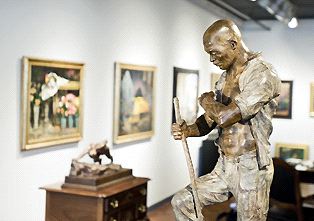
Marin-Price Galleries in Chevy Chase now is showing a selection of Sheppard's paintings and sculptures. The oil paintings range from still life's of lemons to bustling bar scenes.

Sheppard, who taught at the Maryland Institute College of Art and wrote several books on drawing human anatomy, prefers people as subject matter, but does not use live models.

"They're never as good as what's in my head," he says. "If you take someone like Michelangelo, he never used models. All those figures are made up from his knowledge of anatomy. He can twist them and make them do whatever he wants to do with them."

A further link to his classical roots, Sheppard believes an artist's ability to depict the human figure is the true test of his talents.

"Before the abstract thing came along, the highest form of art was the human figure, from the Greeks on down. Then you had portraiture, then you had landscape and then you had still life, but they were ranked in that order. So when you look back at the Renaissance or the Baroque period, the greatest artists were always the figure painters," Sheppard says.

Born in Owings Mills, a suburb of Baltimore, Sheppard's art education began when he was admitted to MICA in 1948 after high school. He studied under Jacques Maroger, the former technical director of the Louvre in Paris. Credited with rediscovering the lead-based medium 17th century master painters used, Maroger, gallery owner Francisco Marin-Price says, is highly regarded across the Atlantic.

"In Europe, if you go to art school to get a degree in fine art, you cannot graduate unless you do a course in Jacques Maroger," says Marin-Price. "That's how important they think he is."

When Marin-Price opened his gallery in 1992, Sheppard was the first artist he featured. The two met at Vernable, a Dupont Circle gallery that showed Sheppard's pieces where Marin-Price once worked. This is Sheppard's 20th exhibit at the Chevy Chase gallery, and Marin-Price thinks highly of both the man and his art.

"I have never heard him criticize another artist, never," Marin-Price says. "But, if he sees a painting that is really outstanding by somebody else, he compliments them. He never tries to pull them down, which is a very common thing artists do."

Sheppard started his career as a painter, but moved to Italy 40 years ago to pursue sculpting. He says he is self-taught and the transition between mediums was relatively easy.

"I draw in a three-dimensional way and paint in a three-dimensional way so I think [in] three dimensions, so it wasn't a big step to go from the painting to the sculpture," he says.

Sheppard owns a 300-year-old farm in Pietrasanta (Italian for holy stone), a town in northern Italy that has some of the world's best foundries. A hotspot for sculptors and artists, it became well-known when sculptors such as Michelangelo went there for its statuary, which is a soft, grainless stone. Sheppard, who creates his sculptures mostly in Italy, divides his time between his Pietrasanta and Baltimore residences. Currently, he is working on a nine-foot sculpture of Baltimore Orioles third baseman Brooks Robinson.Some of the work featured in the Marin-Price exhibit may make its way to the Leroy Merritt Center for the Art of Joe Sheppard, a gallery established by the University of Maryland, University College, in Adelphi. The gallery opened in April, and Marin-Price says the timing is a rarity for artists.

"That is a huge, huge event in the life of an artist because most artists do not end up with that distinction until they're very well dead," Marin-Price says.

The three sections of the gallery exhibit Sheppard's drawings, paintings and sculptures. With its windows and open space, the sculpture garden consists of 25 works that span Sheppard's career and vary in medium from terra cotta to marble. Attached to the sculpture garden is a gallery with paintings that will rotate every year. As an educational institution, UMUC saw a kindred spirit in Sheppard's past teaching career, so the study center devoted to his personal collection of books and his original drawings also serves as an interactive, educational exhibit.

"You're surrounded by a lot of his anatomy drawings," UMUC Arts Program Director Eric Key says. "You'll be able to go in and pull out the drawer and pull out the pieces and study [them]."

The center was funded by the late philanthropist and commercial real estate developer Leroy Merritt, who was a personal friend of Sheppard's. Merritt died in January before the center opened.

Despite his acclaim and accomplishments, Sheppard says he still has aspirations as an artist. Forever admiring the masters of the past, he looks to those who inspire him as the standard he hopes to reach.

"I look at [17th century Flemish Baroque] Ruben's painting or Rembrandt's painting. I haven't achieved that yet, and I want to, so that's what I hold up as my model," he says.

Sculpture photo by Anthony Castellano/The Gazette
Photos courtesy University Maryland, University College

Wednesday, August 25, 2010

Road Warriors: Crystal Castles (Last article for Express)

For Crystal Castles, the road is home — literally. Neither beatmaker Ethan Kath or singer Alice Glass has an actual residence outside of whatever vehicle they're taking to their next gig.

In fact, the Canadian experimental electro duo's April release, "Crystal Castles (II)," was recorded on the road during lulls between shows. The album's production venues spanned continents, from a vacant convenience store in Detroit to a church in Iceland.

"We were on tour for so long that it made no sense to pay for our apartments any longer. So, we just left our apartments behind," said Kath. When the first leg of their tour wrapped up, the band had no home left to return to. "[W]e would just stay in the last city of the tour and just find a spot to set up our keyboards and pedals and just record wherever we were," Kath said.

The two began making music together in 2004 in Toronto, mixing deep-house dance beats with walls of synthesized sound. Kath figured the collaboration with Glass would be a fleeting thing, in the vein of the one-hit '80s punk wonders he obsessively collected on vinyl.

"The bands are unknown, they've released one 7-inch, gone on a tour and then broken up — I thought we could be that band for some kids in 30 years," Kath explained.
                         
But even if he couldn't predict their staying power, Kath knew from the moment he saw a young Glass perform in 2004 that she was the X-factor he was looking for to match the wild instrumentals he'd been working on.

"She was playing in this small punk club in Toronto which holds like 40 or 50 people, and the people who were there were all these Toronto punk legends from the '80s that everybody knows ... and they were all telling her to [expletive] off," Kath recalled. "And she was, in return, calling them [expletive] and spitting beer at them — and she was 15. I was like, 'This is the most powerful girl I've ever seen. I've never seen such a tiny girl stand up to a room full of punk biker guys. This is insane.'"

After recording a batch of demos in 2005, momentum started to build for the band when they were approached by Milo Cordell of the band The Big Pink, who offered to release their songs on his label, Merok Records. While Kath was only expecting Cordell to press about 50 copies of the band's first 7-inch, Cordell informed him that the number would be closer to 500.

"I said, 'Well, you're going to be stuck with 450 copies for the rest of your life,' Kath joked.

Three days later after the release, all 500 were gone — and Crystal Castles were planning a U.K. tour.

Since embarking on that first tour in 2006, the two have been constant road warriors — with just one major setback. In 2008, Glass was in a car accident that broke two of her ribs. Though she'd been given doctor's orders to take six weeks off, she was back performing after two — no small feat for a performer who scales amps, drumkits and whatever else is on the stage.
                         
"She's possessed," Kath laughed.

The band is currently headlining the HARD Summer Tour, which includes a Friday-night stop at the 9:30 Club. They'll release a few extra B-sides in October when another single off "Crystal Castles (II)" drops, and their tour will finish up in December.

After that, the two will float around some other country until the next tour starts, which is business as usual.

"So we'll just stick around there," said Kath, "Just hang out. I guess work on stuff."

» 9:30 Club, 815 V St. NW; with Rusko, Sinden, and Destructo; Fri., Aug. 20, 7 p.m., $35.

Written by Express contributor Topher Forhecz
Photo courtesy Crystal Castles

Friday, August 13, 2010

Original Blend: Patton Oswalt

You know what's not funny? When you're a comedian and someone steals your jokes. So, when Patton Oswalt heard that the 2010 valedictorian of Columbia University's School of General Studies had pinched one of his jokes for a speech, it was no laughing matter.

The stand-up veteran, who makes regular appearances on Showtime's "United States of Tara" as well as lending his voice to TBS' "Neighbors From Hell," got an apology from the grad, and now Oswalt is on the road and working on new material for an album set to drop next year.

Oswalt spoke to Express about his voice-acting career, his year-old daughter and the ever-vigilant eye of the Internet.

» EXPRESS: How did you get into voice acting?
» OSWALT: I can't really remember how that happened. I think someone saw me doing stand-up and brought me into do some voices and it grew from there.

» EXPRESS: How do you prepare for your different voice-acting roles? Do you try out a bunch of different voices?
» OSWALT: It's always cold reading, so there's no preparation. You just go in and they kind of flap the script down and you read it.

» EXPRESS: Your daughter was born last year in April, how has your first year of fatherhood gone?
» OSWALT: Sleep deprived, but fun. I can't complain. I like being a dad; it ended up working out really well.

» EXPRESS: Did anyone give you good advice about fatherhood?
» OSWALT: It's your own unique experience, and I was told that by enough people that it wasn't a shock when it was a shock.

» EXPRESS: How did you find out about the Columbia incident?
» OSWALT: Someone sent me a link and then the New York Times called me about it before I knew what was going on.

» EXPRESS: Couldn't have seen that coming.
» OSWALT: It was weird. I was like, "Oh, I don't even want to talk about this, but now I guess I have to." The Internet breeds suspicion, so what are you going to do?

» Warner Theatre, 513 13th St. NW; Sat., Aug. 14, 8 p.m., $27 - $34.50.

Written by Express contributor Topher Forhecz
Photo courtesy Patton Oswalt

Friday, August 6, 2010

Heavy Metal Woodstock: Jeff Krulik, "Heavy Metal Picnic"

Maryland's own Woodstock: That was what Billy Gordon was shooting for in May of 1985 when he hosted the Full Moon Jamboree on a piece of land known as The Farm in Potomac, Md. The party lasted only a weekend, but with more than a thousand people in attendance — including some disgruntled police — the Jamboree propelled itself into local-music infamy.

Twenty-five years later, "Heavy Metal Parking Lot" director Jeff Krulik revisits the notorious party in his new documentary, "Heavy Metal Picnic." Krulik decided to make the film after screening some footage of the party shot by a friend who'd been armed with a home-video camera and a CBS microphone swiped from Ronald Reagan's inauguration ceremony.

Krulik then tracked down folks who were at the Jamboree, and those interviews offer viewers a glimpse into the heyday of Maryland's rock scene.

» EXPRESS: What was it about the footage that attracted you to the project?
» KRULIK: It's funny; it's very genuine. ...Everybody was part of that scene so they were kind of making their own home movie. Everybody just let it all hang out for their friends on camera. It's a real kind of window into this period, which is great because this is a time way before cell-phone cameras, way before the proliferation of home video — home video was very much in its infancy. Nobody had cameras and, of course, in a situation like this party, [where the crew] had a CBS microphone, it was like, "What? Is this the news?" And yet, it couldn't be farther from the news. It was just this giant kind of playground all captured on tape. Because footage from that period is really rare, when you get right down to it, that's why it really appealed to me.

» EXPRESS: How did people who were at the party react when they saw the film?
» KRULIK: They were amused and excited and interested and really nostalgic. It'd be like you watching whatever period of time you were really coming of age or really just, you know, sowing your oats. If you saw a video of it, as long as you weren't doing anything too embarrassing, you'd probably really enjoy it. And everybody who I've screened it for who was part of it really got a kick out of it.

» AFI Silver Theatre, 8633 Colesville Road, Silver Spring; Fri. Aug. 6, $10.

Written by Express contributor Topher Forhecz
Photo courtesy Jeff Krulik